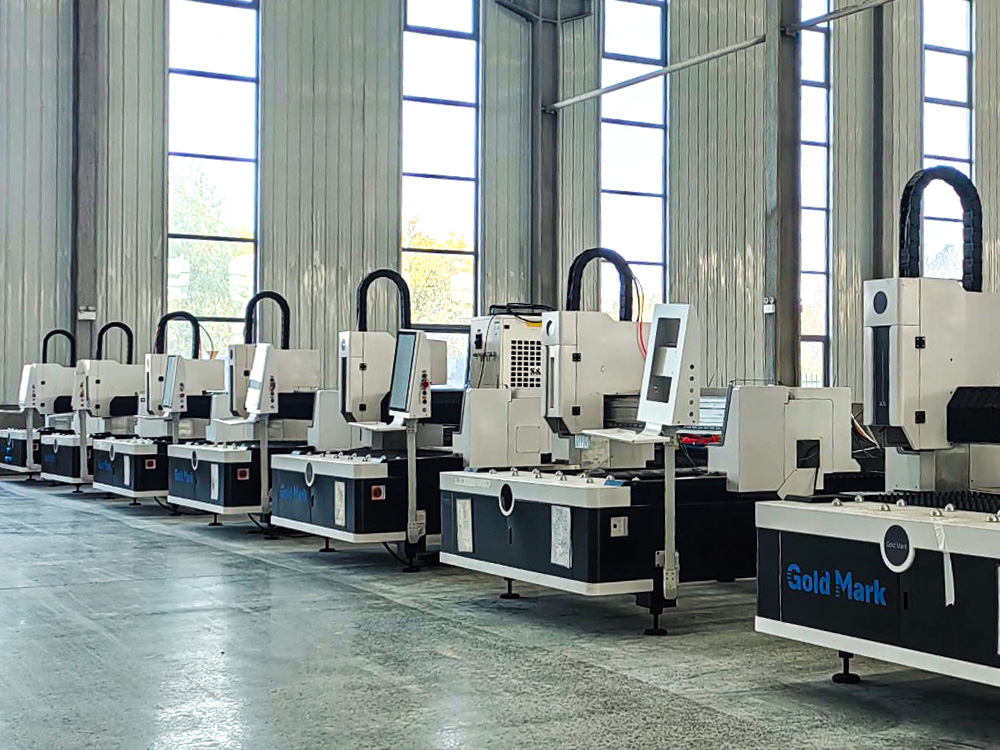
The Open-Type 3015 (3m x 1.5m bed) is undeniably the most versatile and highly profitable footprint for a mid-sized metalworking facility. Its “multi-material” capabilities are genuinely extraordinary—provided those materials belong to the metal family.
When we discuss “seamless multi-material cutting” in the context of a 1-micron solid-state fiber laser, we are referring to its ability to instantly transition between diverse metallic alloys without physical hardware changes.
Modern fiber lasers possess the specific beam wavelength (typically around 1064 nm) that is highly absorbed by metals.
Ferrous Metals: It cuts carbon steel and stainless steel with blistering speed and zero-taper precision.
Reflective Non-Ferrous Metals: Unlike legacy CO2 lasers, which struggled with back-reflection, a modern fiber laser seamlessly processes highly reflective metals like aluminum, copper, and brass without damaging its own optics.
For these applications, the Open-Type 3015 is unmatched. But what happens when you introduce a non-metallic composite into this high-intensity optical environment?
To understand why a fiber laser fails on Carbon Fiber Reinforced Polymers (CFRP), we must look at the material’s structural anatomy. CFRP is not a uniform material; it is a matrix consisting of two entirely different components with wildly contrasting thermal properties.
The Carbon Strands: The structural woven fibers themselves have an incredibly high vaporization point (sublimating at roughly 3,600°C).
The Epoxy Resin: The polymer matrix binding the fibers together has a very low thermal threshold, often melting or burning at temperatures as low as 150°C to 300°C.
A standard continuous-wave (CW) fiber laser relies on thermal ablation—it melts or vaporizes the material.
When the intense 1-micron beam hits the carbon fiber sheet, it must generate enough concentrated heat to vaporize the tough carbon strands. However, this massive thermal energy instantly conducts outward into the surrounding material.
Delamination: Long before the carbon vaporizes, the surrounding epoxy resin boils, burns, and recedes. This destroys the bond between the fiber layers, causing severe delamination at the cut edge.
Charring and Structural Failure: The edge is left charred, frayed, and structurally compromised. Because the very purpose of carbon fiber is its high strength-to-weight ratio, destroying the resin matrix renders the part utterly useless for aerospace or automotive applications.
Beyond ruined material, there is a severe safety hazard to consider, particularly with an Open-Type architecture.
When the epoxy resin in carbon fiber is vaporized by a high-power laser beam, it does not just produce harmless smoke. It undergoes thermal degradation, releasing a highly toxic cocktail of hazardous fumes, including Volatile Organic Compounds (VOCs), microscopic carbon particulates, and potentially Hydrogen Cyanide (HCN) depending on the resin chemistry.
An Open-Type 3015 machine relies on down-draft zoned extraction, which is perfectly adequate for heavy metallic slag and metal dust. However, it is not designed to capture the insidious, toxic, and highly buoyant fumes generated by burning polymers. Processing CFRP on an open bed exposes your operators to severe respiratory hazards and violates industrial safety compliance codes.
If your business strategy demands the processing of carbon fiber sheets, you must invest in technologies specifically engineered for composites.
For the vast majority of job shops, the waterjet is the optimal solution for CFRP. Using a high-pressure stream of water mixed with garnet abrasive, a waterjet uses mechanical erosion rather than thermal ablation. Because it is a “cold cutting” process, there is zero Heat-Affected Zone (HAZ), no melted resin, and no toxic fumes.
If extreme micro-precision is required, the industry uses specialized USP lasers (Femtosecond or Picosecond lasers). These lasers pulse light in fractions of a trillionth of a second. The energy duration is so brief that the carbon strands are vaporized before the heat has time to conduct into the surrounding epoxy resin. This is known as “cold ablation.” However, USP lasers are highly specialized, drastically slower on thick materials, and cost exponentially more than standard fiber lasers.
For simpler geometries and edge trimming, mechanical CNC routing with specialized diamond-coated compression bits remains a highly effective and economical method for cutting composite panels.
| Technology | Process Type | Heat-Affected Zone (HAZ) | Edge Quality on CFRP | Capital Cost |
| Standard Fiber Laser | Thermal (Continuous) | Severe (Destroys part) | Charred, Frayed, Delaminated | Medium |
| Abrasive Waterjet | Mechanical (Cold) | Zero | Excellent, Smooth | Medium |
| USP Laser (Femto) | Photomechanical (Cold) | Negligible | Micro-Precision, Pristine | High |
| CNC Router | Mechanical (Cold) | Zero | Good (Requires specific tooling) |
As a manufacturer, your path to profitability lies in deploying the right tool for the right job.
The Open-Type 3015 Fiber Laser is an unrivaled profit engine for sheet metal fabrication. It will flawlessly cut 15mm steel, instantly switch to 3mm aluminum, and tackle highly reflective copper without hesitation. That is the true definition of multi-material processing.
However, we must respect the boundaries of physics. Attempting to force a metal-cutting thermal laser to process advanced chemical composites like carbon fiber will only result in scrapped materials, ruined edges, and unsafe working conditions.
 GM-F Series
 GM-E Series
 GM-EP Series
 GM-FL Series
 GM-FP Series
 GM-H Series
 GM-G Series
 GM-GP Series
 GM-1390S Series
 GM-FR Series
 GM-EPL Series
 GM-TS Series
 GM-T2 Series
 GM-T2S Series
 GM-T2L Series
 GM-T3 Series
 GM-T3L Series
 GM-T4 Series
 GM-FT Series
 GM-FTE Series
 GM-FTP Series
 GM-W Series
 GM-WFA Series
 GM-WA Series
 GM-C Series
 GM-CP Series
 GM-EPB Series
 GM-HPB Series
 GM-TPBS Series
 GM-TPB Series