In the heavy equipment, fitness apparatus, and structural framing sectors, processing tubular metal has historically been a logistical nightmare. When job shop owners hear the claim that transitioning to an automated laser system can increase production efficiency by 300%, they are understandably skeptical. In traditional manufacturing, a 15% gain is considered a massive victory.
However, as an engineering reality in 2026, a 300% increase is not marketing hyperbole; it is a mathematical certainty. This dramatic leap in productivity does not come merely from cutting metal faster. It comes from entirely collapsing a multi-machine, multi-operator supply chain into a single, automated photonics platform.
This technical briefing explains how a modern automatic tube laser cutter machine consolidates legacy workflows, eliminates volumetric waste, and redefines unit economics for tube and pipe fabricators.
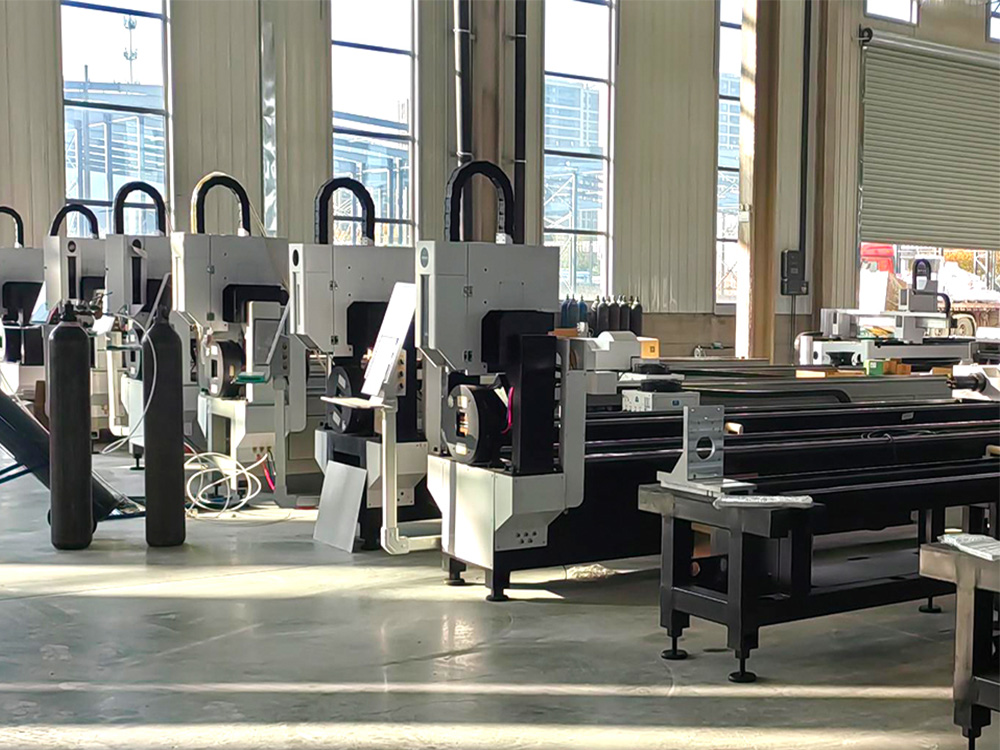
To understand the 300% efficiency gain, we must first diagnose the severe inefficiencies of traditional tube fabrication.
Historically, creating a structural tubular component with intersecting angles and mounting holes required a grueling, sequential journey across the shop floor:
The Band Saw: The raw 6-meter pipe is cut to length.
The Deburring Station: The harsh, jagged saw-cut edges are manually ground smooth.
The Drill Press: The tube is moved to a machinist who manually measures, center-punches, and drills mounting holes.
The Milling Machine: If complex copes, slots, or fish-mouth intersections are required to join two tubes together, the part is moved again to a CNC mill.
Every time that tube is picked up, moved to a new machine, re-clamped, and re-measured, you are bleeding capital. You are paying for setup time, not production time.
The fundamental advantage of upgrading to a modern laser cutter tube platform is process consolidation.
By deploying a cnc fiber laser tube cutter, you are effectively replacing the band saw, the deburring wheel, the drill press, and the milling machine with one piece of equipment.
The Single Pass: The raw tube is loaded into the machine. The laser cuts the outer perimeter to the exact length, pierces and cuts all internal mounting holes, and shapes the complex end-coping for joint intersections—all in a single, continuous CNC operation.
Weld-Ready Edges: Because the fiber laser vaporizes the metal with a microscopic kerf and utilizes high-pressure assist gas, the resulting edge is pristine, dross-free, and instantly ready for robotic welding. The deburring department is entirely bypassed.
Even the fastest laser is useless if it is waiting for an operator to manually load heavy steel pipes. The true 300% multiplier is unlocked through intelligent material handling.
An automatic tube laser cutter machine is equipped with a bundle-loading magazine.
Zero-Intervention Loading: The operator simply drops a 3-ton bundle of raw steel, aluminum, or brass tubing into the staging magazine.
Kinematic Feeding: The machine’s intelligent sorting arms automatically separate a single tube, measure its exact length and deformation, and drop it into the feeding chucks. While the laser is cutting one tube, the automation system is already staging the next one. This creates a continuous, “lights-out” production cycle that entirely eliminates spindle downtime.
When utilizing a basic laser cutter metal tube system from a decade ago, fabricators accepted a massive amount of raw material waste. Older mechanical chucks could not push the tube all the way through the cutting head, leaving a “tail” of uncut metal—often 400mm or more—that had to be thrown into the scrap bin.
Today’s systems utilize intelligent, full-stroke pneumatic chucks.
Dynamic Clamping: These chucks automatically adjust their grip pressure based on the wall thickness and profile of the tube (square, round, rectangular, or obround) to prevent crushing thin-walled materials.
Zero-Tailing Technology: The rear chuck can actually pass through the front chuck, pushing the raw material directly to the cutting nozzle. This reduces the wasted tail from 400mm down to a negligible 40mm, dramatically increasing material utilization and lowering the total cost per part.
In structural framing, tubes rarely meet at perfect 90-degree angles. They intersect at complex, multi-axis angles that require highly precise coping (often called “fish-mouthing”) to ensure a tight fit for welding.
If a fabricator uses a dedicated cnc metal fiber laser pipe tube cutter equipped with a 3D cutting head, they unlock true geometric freedom.
Bevel Cutting: Instead of just cutting straight down, the 3D laser head tilts up to 45 degrees. It cuts the exact weld-prep bevel directly into the tube’s edge during the primary severing cut.
Slot and Tab Assembly: Advanced CNC software allows engineers to design “slot and tab” intersections. The laser cuts a tab on one tube and a perfectly matching slot on the intersecting tube. When they reach the welding cell, the tubes click together like puzzle pieces. This makes the assembly self-fixturing, entirely eliminating the need for expensive, custom-built welding jigs.
To quantify the efficiency gain, let us look at the total floor time required to produce a single structural cross-member with four mounting holes and two coped ends.
| Production Phase | Legacy Multi-Machine Method | Automated Tube Laser System |
| Material Handling | 5 mins (Manual forklift to saw) | 0 mins (Bundle loader) |
| Cut to Length | 3 mins (Band saw) | Included in single pass |
| Deburring | 4 mins (Manual grinding) | 0 mins (Pristine laser edge) |
| Hole Drilling | 8 mins (Setup, measure, drill) | Included in single pass |
| End Coping | 10 mins (CNC Mill setup & cut) | Included in single pass |
| Total Cycle Time | 30 Minutes per part | < 3 Minutes per part |
The transition to automated tube processing is no longer a luxury reserved for massive automotive OEMs; it is a baseline requirement for any job shop looking to remain competitive in 2026.
By investing in a complete cnc fiber laser tube cutter ecosystem, you are fundamentally restructuring your unit economics. You are eliminating material waste, bypassing the labor shortages in the deburring and machining departments, and delivering flawlessly precise parts to your welding cells.
 GM-F Series
 GM-E Series
 GM-EP Series
 GM-FL Series
 GM-FP Series
 GM-H Series
 GM-G Series
 GM-GP Series
 GM-1390S Series
 GM-FR Series
 GM-EPL Series
 GM-TS Series
 GM-T2 Series
 GM-T2S Series
 GM-T2L Series
 GM-T3 Series
 GM-T3L Series
 GM-T4 Series
 GM-FT Series
 GM-FTE Series
 GM-FTP Series
 GM-W Series
 GM-WFA Series
 GM-WA Series
 GM-C Series
 GM-CP Series
 GM-EPB Series
 GM-HPB Series
 GM-TPBS Series
 GM-TPB Series